Services
EnquBio's Comprehensive Drug Discovery Solutions & Services
At EnquBio, our expert team delivers high quality, efficient, and dependable R&D solutions that enable pharmaceutical and biotech partners to advance and expand their drug development pipelines.
- Discovery Biology
- Plate-Based Pharmacology
- Immunology
- Ex Vivo Pharmacology
-
In Vivo Pharmacology
- Inflammation & Autoimmune Diseases Models
- Syngeneic and Cell Line-Derived Xenograft (CDX) Models
- Humanized Immuno-Oncology Models
- FLI and BLI based optical in vivo imaging for orthotopic models and drug biodistribution
- Pharmacokinetic and Pharmacodynamic (PK/PD)
- Non-GLP Toxicology
- Other In Vivo Efficacy Models
- Biomarker & Bioanalysis
Western Blot, Protein Expression & Signaling
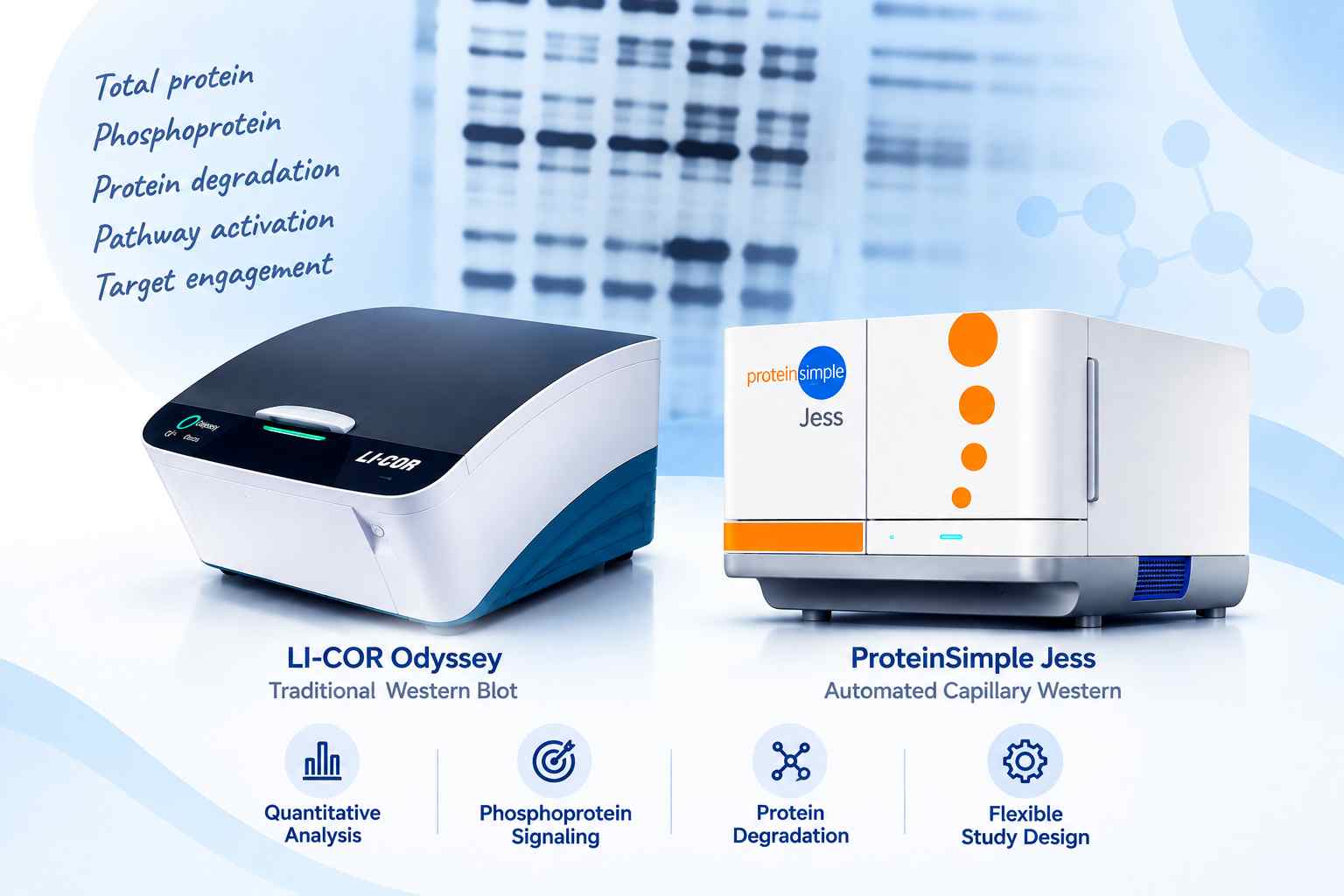
EnquBio is a San Diego-based CRO providing ProteinSimple Jess (Simple Western) automated capillary Western and traditional Western blot services for discovery, pharmacology and translational studies. EnquBio is a Bio-Techne Certified Service Provider for Jess — one of only two in North America — combining certified Simple Western expertise with conventional Western flexibility.
What We Can Evaluate
Protein-level readouts for expression, signaling and targeted protein degradation studies.
Total Protein Expression
Measure treatment-, genotype- or disease-associated changes in target protein abundance.
Phosphoprotein Signaling
Evaluate pathway activation and inhibition using phospho- and total-protein readouts.
Protein Degradation
Confirm target loss and quantify concentration- and time-dependent degradation.
Cleavage & Processing
Assess treatment-associated protein processing, cleavage products and related molecular changes.
Molecular-Weight Confirmation
Evaluate target signal at the expected molecular weight and distinguish additional protein species.
Pathway Modulation
Connect changes in target expression or phosphorylation with downstream mechanism-of-action responses.
Two Complementary Western Approaches
We select the format based on target biology, sample availability, throughput and study objectives.
Traditional Western Blot
Gel electrophoresis + membrane-based immunodetectionA flexible format for custom and exploratory protein studies where direct inspection of band patterns is valuable.
- Broad antibody flexibility
- Direct band visualization
- Molecular-weight-resolved target assessment
- Phosphoprotein and total-protein analysis
- Protein degradation, cleavage and processing studies
- Useful for assay development and troubleshooting
ProteinSimple Jess (Simple Western)
Automated capillary Western (Simple Western) — size-based separation and immunodetectionSimple Western technology on Jess automates sample separation, immunoprobing, washing, detection and data analysis in capillaries for quantitative, reproducible protein measurement. As a Bio-Techne Certified Service Provider, our team is trained and certified directly by ProteinSimple field application scientists.
- Automated size-based Western workflow
- Quantitative peak-based data analysis
- Reduced hands-on processing
- Lower sample consumption than conventional Western workflows
- Chemiluminescent and fluorescent detection options
- Supports phospho/total and sequential RePlex workflows
Choosing the Right Western Format
Both approaches provide molecular-weight-resolved protein information, but their practical strengths differ.
| Study Consideration | Traditional Western | Jess (Simple Western) |
|---|---|---|
| Protein separation | SDS-PAGE | Capillary electrophoresis |
| Detection format | Membrane-based immunoblot | Automated capillary immunodetection |
| Primary readout | Bands | Electropherogram / quantitative peaks |
| Sample consumption | Standard Western workflow | Lower-volume capillary format |
| Hands-on processing | Higher | Lower / automated |
| Best fit | Custom, exploratory and troubleshooting studies | Standardized quantitative and higher-throughput workflows |
Phosphoprotein & Cell Signaling Analysis
Measure pathway activation, inhibition and downstream pharmacodynamic responses at the protein level.
Phospho + total protein readouts
Western blotting can distinguish phosphorylated and total forms of pathway proteins while retaining molecular-weight information, making it useful for confirming signaling responses and treatment mechanisms.
PROTAC & Degrader Support
Western blotting provides direct, molecular-weight-resolved confirmation of target protein loss and is a core analytical tool for targeted protein degradation programs. EnquBio supports concentration-response, time-course, washout and mechanistic studies using both traditional Western blotting and automated capillary Western.

Applications
Western-based protein analysis can support a broad range of discovery and translational programs.
Target Validation
Confirm protein expression and target modulation in relevant biological models.
Mechanism of Action
Connect treatment to target abundance, phosphorylation and downstream pathway effects.
Compound Profiling
Compare concentration- and time-dependent protein responses across test compounds.
Biomarker Confirmation
Validate protein-level changes identified through gene-expression or functional studies.
Protein Processing
Assess cleavage, degradation and additional molecular-weight-resolved protein species.
Translational Pharmacology
Integrate protein-level endpoints with ex vivo and in vivo study readouts.
Sample Types
Protein extraction and assay conditions are optimized according to sample type, target abundance and study design.
How We Design a Protein Study
The Western format is selected around the scientific question and required level of characterization.
Define the Question
Expression, phosphorylation, degradation, processing or pathway response.
Select the Format
Traditional Western or automated capillary Western based on study needs.
Optimize the Assay
Establish antibody conditions, sample loading and appropriate controls.
Quantify & Interpret
Analyze protein responses alongside treatment, dose, time and other pharmacology endpoints.
Frequently Asked Questions
What is the difference between Jess (Simple Western) and traditional Western blot?
Both provide molecular-weight-resolved protein detection. Jess runs the entire Western workflow — separation, immunoprobing, washing and detection — automatically inside capillaries, producing quantitative peak-based data with lower sample input and higher reproducibility. Traditional Western blotting offers broader antibody flexibility and direct band visualization, and remains valuable for custom, exploratory and troubleshooting studies.
How much sample does Jess require?
Jess typically consumes about 3 µL of prepared lysate per capillary data point — far less than a conventional Western workflow — making it well suited to limited primary cells, in vivo study samples and other precious material.
Can Jess measure phosphorylated and total protein from the same sample?
Yes. Phospho- and total-protein readouts can be generated from the same lysate, including sequential RePlex workflows, enabling normalized phospho/total ratios for pathway activation and inhibition analysis.
Can Western blot studies for PROTAC and degrader programs be outsourced?
Yes. EnquBio runs concentration-response (DC50/Dmax), time-course, washout and selectivity studies for targeted protein degradation programs using Jess and traditional Western blotting, delivering quantified data with a complete study report.
Is EnquBio certified to run Jess?
Yes. EnquBio is a Bio-Techne Certified Service Provider for Jess (Simple Western), listed in Bio-Techne’s official certified service provider directory — one of only two providers in North America.

Need a protein-level answer?
Send us your target, sample type and study objective. Our scientists can recommend the appropriate Western format and study design.
Contact Our Scientists →