Services
EnquBio's Comprehensive Drug Discovery Solutions & Services
At EnquBio, our expert team delivers high quality, efficient, and dependable R&D solutions that enable pharmaceutical and biotech partners to advance and expand their drug development pipelines.
- Discovery Biology
- Plate-Based Pharmacology
- Immunology
- Ex Vivo Pharmacology
-
In Vivo Pharmacology
- Inflammation & Autoimmune Diseases Models
- Syngeneic and Cell Line-Derived Xenograft (CDX) Models
- Humanized Immuno-Oncology Models
- FLI and BLI based optical in vivo imaging for orthotopic models and drug biodistribution
- Pharmacokinetic and Pharmacodynamic (PK/PD)
- Non-GLP Toxicology
- Other In Vivo Efficacy Models
- Biomarker & Bioanalysis
Immunoassay Protein Quantification
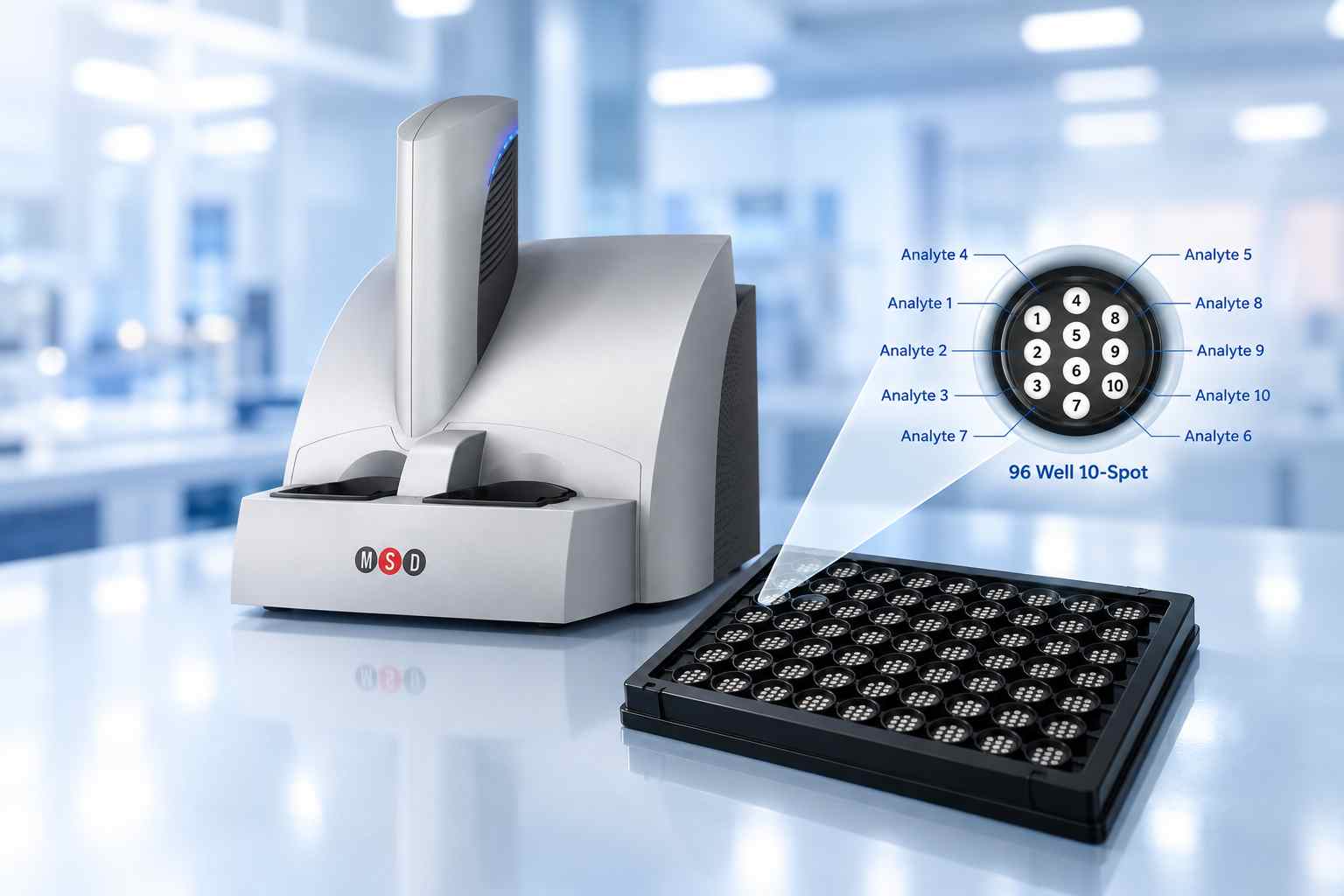
EnquBio is a San Diego-based CRO providing MSD multiplex electrochemiluminescence (V-PLEX, U-PLEX and ultrasensitive S-PLEX), AlphaLISA, HTRF, LEGENDplex and ELISA services for quantifying cytokines, chemokines and soluble proteins in serum, plasma, supernatants, lysates and tissue-derived samples. As an MSD-listed CRO partner, our scientists select and customize the assay format around your analytes, species, matrix and expected concentration range.
What We Measure
From secreted proteins to pathway-specific intracellular signaling biomarkers.
Cytokines, chemokines and secreted proteins
Quantify treatment- and disease-associated changes in serum, plasma, cell culture supernatants, whole-blood-derived samples and other biological matrices.
Defined pathway and phosphoprotein readouts
Quantify selected signaling events from cell or tissue lysates to characterize pathway activation, inhibition and pharmacodynamic response.
Multiple Platforms. One Fit-for-Purpose Strategy.
Different assays solve different problems. We select the format that best fits the biological question and study constraints.
MSD
- Multiplex cytokine and biomarker panels
- Low-abundance analytes
- Limited sample volume
- Soluble and intracellular targets
AlphaLISA
- Rapid protein quantification
- High-throughput workflows
- Miniaturized assay formats
- Soluble and intracellular targets
HTRF
- Phosphoprotein signaling
- Cell-based pathway analysis
- Protein interactions
- Screening and pharmacology studies
LEGENDplex
- Multi-analyte cytokine profiling
- Immune biomarker panels
- Limited sample volume
- Flow-based multiplex detection
ELISA
- Focused biomarker measurements
- Commercially established assays
- Cross-study continuity
- Custom or uncommon targets
Choosing the Right Assay Format
Typical approaches vary by target, matrix, throughput and sensitivity requirements.
| Study Need | Typical Approach |
|---|---|
| Broad cytokine profiling | MSD / LEGENDplex |
| Very low-abundance biomarker | MSD S-PLEX |
| High-throughput single-target quantification | AlphaLISA / HTRF |
| Phosphoprotein signaling | MSD / AlphaLISA / HTRF |
| Focused single-analyte measurement | ELISA |
| Limited sample volume | Multiplex or miniaturized assay formats |
| Custom biomarker strategy | Platform selected based on assay requirements |
Applications
Quantitative protein biomarkers can support both mechanistic and translational decision-making.
Immune & Inflammatory Profiling
Cytokines, chemokines, interferons, growth factors and immune-regulatory biomarkers.
Pharmacodynamic Biomarkers
Measure treatment-associated protein changes across concentration, dose and time.
Intracellular Signaling
Quantify phosphorylation and pathway responses following receptor activation or drug treatment.
Mechanism of Action
Connect compound activity to downstream protein and signaling responses.
Immuno-Oncology
Assess immune activation, suppression and tumor–immune signaling.
Autoimmune & Inflammatory Disease
Profile disease-relevant soluble and intracellular protein biomarkers.
Connect Signaling to Secreted Biomarkers
Protein biomarker analysis is most informative when interpreted in the context of the underlying pharmacology.
Sample Types
Assay selection considers matrix effects, expected analyte abundance, available sample volume and study design.
How We Design a Biomarker Study
The assay is selected around the biology, not the other way around.
Define the Biology
Clarify the pathway, mechanism, treatment response or translational question.
Select Biomarkers
Identify the soluble and/or intracellular biomarkers most informative for the study.
Select the Assay Format
Match platform choice to sensitivity, throughput, multiplexing, matrix and sample volume.
Generate & Interpret Data
Integrate quantitative biomarker results with pharmacology, dose, time and other study endpoints.
Frequently Asked Questions
Which MSD assay formats does EnquBio run?
We run V-PLEX validated panels, U-PLEX custom multiplex configurations and S-PLEX ultrasensitive assays on the
MSD electrochemiluminescence platform, alongside AlphaLISA, HTRF, LEGENDplex and ELISA. If your analytes span
multiple panels, we help configure the most sample- and cost-efficient combination.
How much sample does an MSD multiplex panel need?
A multiplex panel typically requires 25–50 µL of serum, plasma or supernatant per well, run in
duplicate, with up to 10 analytes quantified from a single well. Exact volumes are confirmed at study setup.
How sensitive are MSD assays compared with ELISA?
MSD electrochemiluminescence typically offers a wider dynamic range and greater sensitivity than conventional
ELISA, and S-PLEX assays extend detection to sub-pg/mL levels for low-abundance biomarkers.
Which species and sample types are supported?
Human, mouse, rat and non-human primate panels are available for most cytokine and chemokine targets. We
routinely analyze serum, plasma, culture supernatants, cell lysates and tissue homogenates.
Does EnquBio operate under GLP?
No. EnquBio provides fit-for-purpose, exploratory bioanalysis for research and translational decision-making,
which keeps studies fast and flexible. Data are intended for research use, not regulatory submission.

Have a biomarker question?
Send us your targets, matrix and study objective. Our scientists can recommend a fit-for-purpose assay strategy.
Contact Our Scientists →