Services
EnquBio's Comprehensive Drug Discovery Solutions & Services
At EnquBio, our expert team delivers high quality, efficient, and dependable R&D solutions that enable pharmaceutical and biotech partners to advance and expand their drug development pipelines.
- Discovery Biology
- Plate-Based Pharmacology
- Immunology
- Ex Vivo Pharmacology
-
In Vivo Pharmacology
- Inflammation & Autoimmune Diseases Models
- Syngeneic and Cell Line-Derived Xenograft (CDX) Models
- Humanized Immuno-Oncology Models
- FLI and BLI based optical in vivo imaging for orthotopic models and drug biodistribution
- Pharmacokinetic and Pharmacodynamic (PK/PD)
- Non-GLP Toxicology
- Other In Vivo Efficacy Models
- Biomarker & Bioanalysis
Immunophenotyping & Cellular Biomarkers
EnquBio is a San Diego-based flow cytometry CRO providing multicolor and spectral flow cytometry services for immune phenotyping, activation and differentiation markers, intracellular signaling, receptor occupancy and cellular pharmacodynamic readouts. We analyze whole blood, PBMCs, tissue-derived single-cell suspensions and cultured cells, with custom panels designed for human, mouse and non-human primate studies.
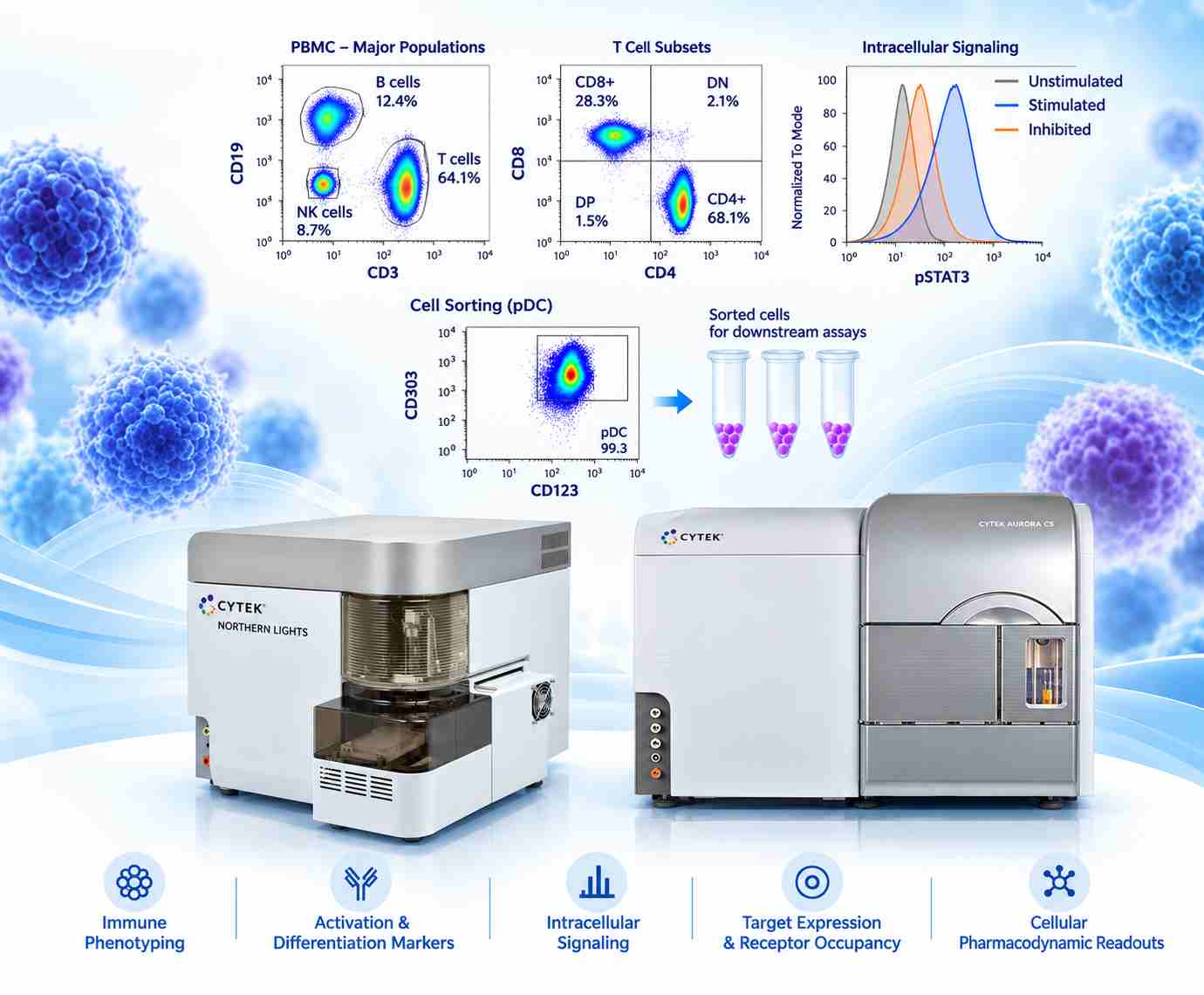
What We Can Measure
From cell identity to functional state, signaling and treatment response.
Immune Cell Profiling
Define lymphoid, myeloid and other cellular populations using customized multicolor panels.
Activation & Differentiation
Measure activation, exhaustion, differentiation and maturation markers across treatment conditions.
Intracellular Signaling
Assess phosphoprotein and pathway responses using intracellular flow-based readouts.
Target Expression
Quantify cell-surface or intracellular target expression across defined cell populations.
Receptor Occupancy & Binding
Evaluate target engagement, receptor occupancy and ligand or antibody binding where assay design permits.
Cellular Pharmacodynamic Biomarkers
Connect treatment to changes in phenotype, signaling, proliferation, viability or functional state.
High-Dimensional Flow Cytometry
Flexible panel design for complex immune and cellular biomarker studies.
Resolve complex cellular populations with fit-for-purpose panels
EnquBio supports high-dimensional immunophenotyping using spectral and multicolor flow cytometry. Panels are designed around the biology of the study rather than a fixed marker list, enabling simultaneous assessment of lineage, activation, differentiation, signaling and pharmacodynamic biomarkers.
Assays can be developed for human, mouse and non-human primate samples depending on reagent availability and study requirements.
From Biological Question to Optimized Panel
A strong flow assay starts with the biology, not the number of colors.
Applications
Cellular biomarker analysis across discovery, ex vivo, in vivo and translational studies.
Immuno-Oncology
Profile tumor- and treatment-associated changes in T cells, NK cells, myeloid populations and other immune subsets.
Autoimmune & Inflammatory Disease
Characterize disease-relevant immune populations, activation states and treatment responses.
Pharmacodynamic Biomarkers
Measure cell-specific changes across dose, time and treatment conditions.
Mechanism of Action
Connect compound activity to changes in cellular phenotype, target expression and signaling.
Humanized In Vivo Models
Evaluate peripheral and tissue immune-cell responses as downstream biomarker endpoints.
Ex Vivo Pharmacology
Combine compound treatment with immune-cell phenotyping and functional response analysis.
Representative Cellular Readouts
Examples of the questions flow cytometry can address within a biomarker program.
| Biological Question | Representative Readout |
|---|---|
| Which immune populations change after treatment? | Population frequency and absolute/relative abundance |
| Are cells activated or differentiated? | Activation, differentiation, maturation and exhaustion markers |
| Is the target expressed on the relevant cell type? | Cell-specific target expression and signal intensity |
| Does treatment modulate intracellular signaling? | Phosphoprotein or intracellular pathway readouts |
| Does the therapeutic bind its intended cellular target? | Binding / receptor occupancy / target-engagement assay |
| Does phenotype correlate with pharmacology? | Integrated cellular PD biomarker analysis across dose and time |
Sample Types
Assay design accounts for cell number, viability, sample handling and expected biomarker abundance.
How We Design a Flow Cytometry Study
Scientific intent drives panel design, assay optimization and data interpretation.
Define the Biology
Identify relevant populations, pathways and treatment-response questions.
Design the Panel
Select markers, controls and assay conditions around sample and platform constraints.
Run & QC
Acquire data with appropriate compensation/unmixing, controls and quality assessment.
Analyze & Interpret
Connect cell-specific biomarker changes with treatment, dose, time and pharmacology.
Frequently Asked Questions
What sample types can be analyzed by flow cytometry?
Whole blood, PBMCs, bone marrow, tissue-derived single-cell suspensions (including tumor) and cultured cells.
Our workflow covers tissue dissociation, cell isolation, staining, acquisition and analysis.
Can EnquBio design a custom flow cytometry panel for my study?
Yes. Panels are designed around your biology, species and study objectives — from lineage identification to
activation, exhaustion, intracellular cytokine and proliferation readouts — and run with consistent gating so
results are comparable across time points and treatment groups.
What is the advantage of spectral flow cytometry?
Spectral analysis captures the full emission spectrum of each fluorochrome, enabling larger panels and better
separation of closely overlapping markers than conventional compensation-based cytometry — more parameters
from the same limited sample.
Can receptor occupancy be measured?
Yes. Receptor occupancy and target-binding assays can be developed to support dose selection and
pharmacodynamic assessment for antibody and other biologic programs.
Which species are supported?
Human, mouse and non-human primate samples are routinely analyzed, supporting preclinical and translational
study designs.

Have a cell population or biomarker question?
Send us your species, sample type, markers and study objective. Our scientists can help design a fit-for-purpose flow cytometry strategy.
Contact Our Scientists →