Services
EnquBio's Comprehensive Drug Discovery Solutions & Services
At EnquBio, our expert team delivers high quality, efficient, and dependable R&D solutions that enable pharmaceutical and biotech partners to advance and expand their drug development pipelines.
- Discovery Biology
- Plate-Based Pharmacology
- Immunology
- Ex Vivo Pharmacology
-
In Vivo Pharmacology
- Inflammation & Autoimmune Diseases Models
- Syngeneic and Cell Line-Derived Xenograft (CDX) Models
- Humanized Immuno-Oncology Models
- FLI and BLI based optical in vivo imaging for orthotopic models and drug biodistribution
- Pharmacokinetic and Pharmacodynamic (PK/PD)
- Non-GLP Toxicology
- Other In Vivo Efficacy Models
- Biomarker & Bioanalysis
Gene Expression & Molecular Bioanalysis
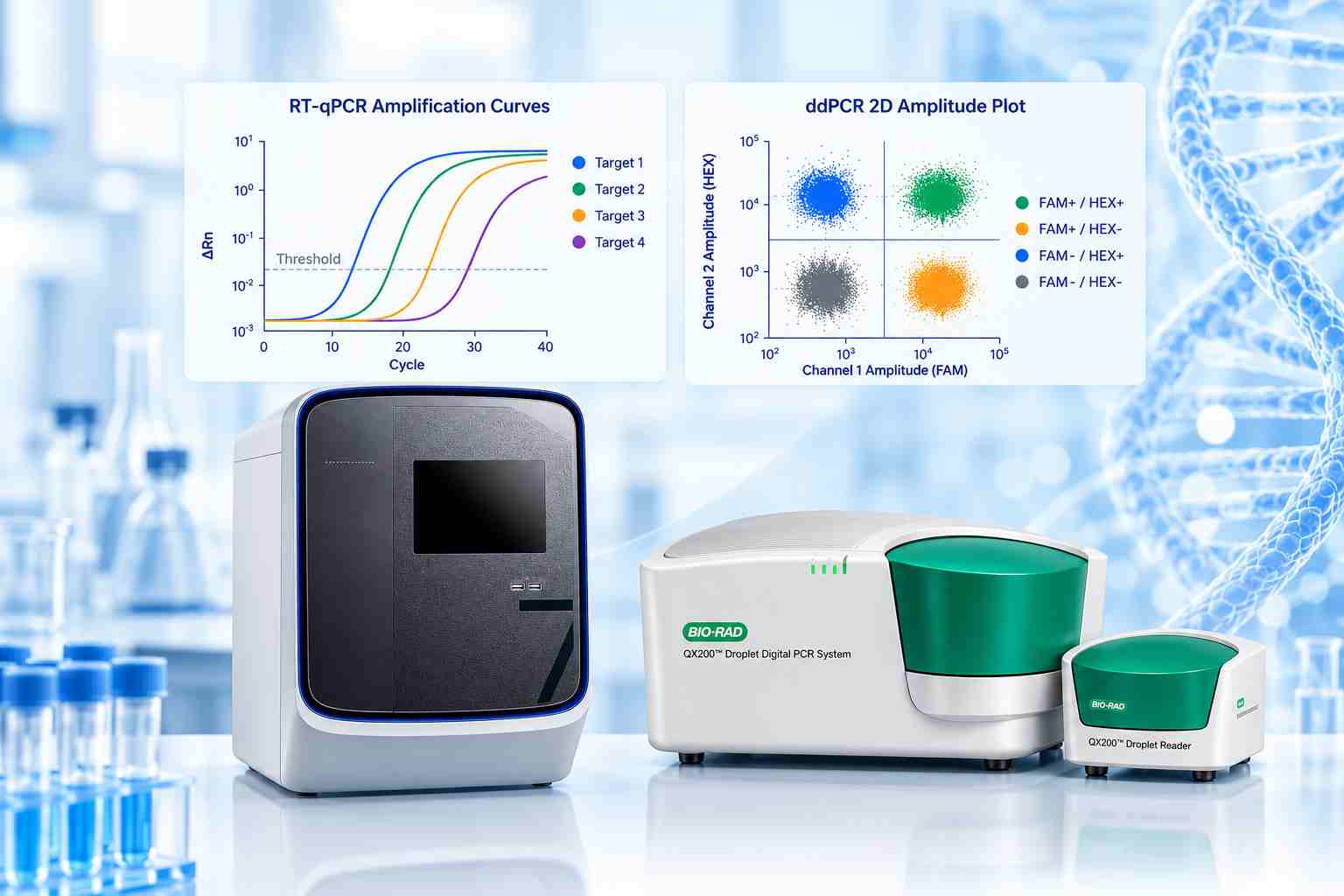
EnquBio is a San Diego-based CRO providing RT-qPCR and Droplet Digital PCR (ddPCR) services for gene expression profiling, absolute nucleic acid quantification, copy number analysis and molecular pharmacodynamic readouts. We analyze cells, blood-derived samples and tissues from multiple species, including non-human primate study samples, with assays developed or adapted around your target and matrix.
What We Can Measure
Molecular endpoints from relative gene-expression changes to absolute nucleic-acid quantification.
Gene Expression
Measure treatment-, genotype- or disease-associated changes in transcriptional biomarkers.
Absolute Quantification
Quantify nucleic-acid targets with partition-based ddPCR workflows where absolute measurement is required.
Copy Number Assessment
Evaluate target copy number and genomic abundance using fit-for-purpose molecular assays.
Molecular Pharmacodynamic Biomarkers
Track treatment-associated molecular responses across concentration, dose and time.
Target & Pathway Confirmation
Confirm pathway modulation or target knockdown at the RNA level in relevant biological models.
Custom Molecular Assays
Develop or adapt assays for study-specific targets, species and biological matrices.
Two Complementary Molecular Platforms
RT-qPCR and ddPCR answer related but different quantitative questions.
Relative and quantitative gene-expression analysis
RT-qPCR provides an efficient and scalable approach for targeted gene-expression studies and molecular pharmacodynamic readouts across multiple treatment conditions.
- Gene-expression profiling
- Relative quantification
- Target knockdown confirmation
- Pathway-response studies
- Multi-condition pharmacology experiments
High-sensitivity absolute nucleic-acid quantification
ddPCR partitions the reaction into many individual measurements, supporting precise absolute quantification and applications where low-level changes or copy number are important.
- Absolute target quantification
- Copy number assessment
- Low-abundance target measurement
- Small fold-change confirmation
- Orthogonal confirmation of selected molecular endpoints
From Biological Sample to Molecular Readout
A complete workflow from sample preparation through quantitative molecular analysis.
Applications
Targeted molecular analysis to support discovery, pharmacology and translational research.
Mechanism of Action
Connect compound activity to downstream transcriptional and pathway responses.
Target Knockdown
Confirm siRNA, shRNA or other target-modulation effects at the RNA level.
Pharmacodynamic Biomarkers
Measure molecular responses across dose, time and treatment conditions.
Immune & Inflammatory Biology
Quantify cytokine, interferon, activation and pathway-related gene-expression responses.
Oncology & Targeted Therapy
Assess molecular markers associated with target modulation, signaling and treatment response.
Translational Bioanalysis
Measure predefined molecular biomarkers in clinically relevant and preclinical sample matrices.
Choosing the Right Molecular Readout
Platform selection depends on the biological question, expected abundance and required quantitative resolution.
| Study Need | Typical Approach |
|---|---|
| Routine targeted gene-expression analysis | RT-qPCR |
| Multi-condition pharmacology studies | RT-qPCR |
| Absolute nucleic-acid quantification | ddPCR |
| Copy number assessment | ddPCR |
| Low-abundance target measurement | ddPCR or optimized RT-qPCR, depending on study requirements |
| Orthogonal confirmation of a selected endpoint | RT-qPCR and/or ddPCR |
| Custom molecular biomarker strategy | Platform selected based on target, matrix and required sensitivity |
Sample Types
DNA/RNA extraction and assay conditions are tailored to the sample matrix and study objective.
How We Design a Molecular Bioanalysis Study
Assay design begins with the biological question and the quantitative decision the data need to support.
Define the Target
Clarify genes, molecular biomarkers, species, sample type and expected biological response.
Select the Platform
Choose RT-qPCR or ddPCR based on quantification strategy, abundance and assay requirements.
Optimize & Run
Establish extraction, assay conditions, controls and normalization as appropriate.
Analyze & Interpret
Connect molecular changes with treatment, dose, time and other pharmacology endpoints.
Frequently Asked Questions
What is the difference between RT-qPCR and ddPCR?
RT-qPCR measures relative gene expression against calibration curves and is well suited to high-throughput
profiling across large sample sets. Droplet Digital PCR (ddPCR) partitions each reaction into thousands of
droplets and counts positives directly, providing absolute quantification without standard curves — ideal
for low-abundance transcripts, rare targets and precise copy number measurement.
When should I choose ddPCR over qPCR?
Choose ddPCR when you need absolute copies per microliter, when targets are near the detection limit, when small
fold-changes must be resolved, or when inhibitor-prone matrices such as blood or tissue make calibration-based
quantification unreliable.
Can EnquBio analyze non-human primate and other animal samples?
Yes. We routinely process blood and tissue from multiple species, including non-human primate study samples,
for gene-level readouts.
Can assays be developed for new targets?
Yes. Assays are developed or adapted to your specific target, species, sample matrix and study objective,
and qualified fit-for-purpose before study samples are run.
What is delivered at the end of a study?
Quantified expression or copy-number data, QC performance, statistics where applicable, and a complete study
report with interpretation.

Have a molecular biomarker question?
Send us your target list, sample type and study objective. Our scientists can help select the appropriate molecular assay strategy.
Contact Our Scientists →